
Home · Solutions · Smart Glasses
Hands free. Eyes forward.
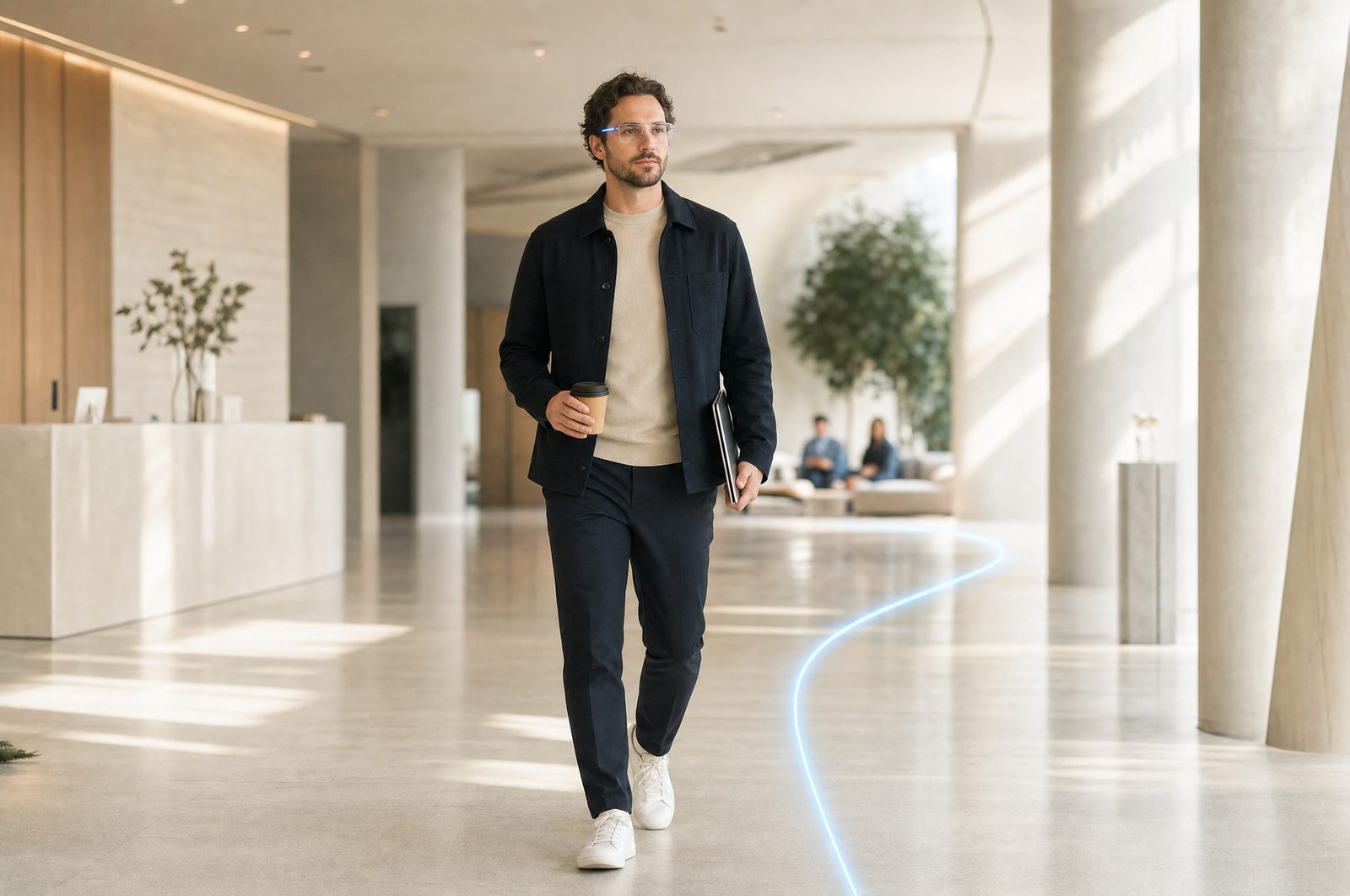
Taking out a phone means stopping what you were doing. Smart glasses put the information you need in front of your eyes, so your hands stay on the work and your eyes stay on the site. GOVR develops smart glasses solutions for wayfinding, live interpretation, industrial work guidance, training and medicine.
What changes
Checking a phone
Seeing it in view
Every time you check a screen, the work pauses. With the information in view, the work carries on while you check.
Where it is used
Every site is different, so how the glasses recognize and how they display are designed for each one.
Wayfinding
Indoor space and walking positionThe route ahead
Overlays the route in the walker's view. Direction is clear without looking down at a screen, so attention stays on the way ahead. Especially useful in complex indoor spaces and large facilities.
Live interpretation
What the other person saysTranslated captions
Recognizes what the other person says and shows it as translated captions in view. With no device held between you, the conversation keeps its flow.
Industrial safety · Work guidance
Equipment to inspectCheck points and work steps
Recognizes the equipment to inspect, highlights check points and guides the work step by step. With both hands free to follow the procedure, the work runs at a different pace from carrying a manual. It also serves safety, such as warnings near hazardous zones.
Training
Real equipment and spacesTraining information
Hands-on training for military personnel and students. Training information is overlaid on real equipment and spaces, so drills can be repeated on site without a separate simulator.
Medicine
Patient ID bands and clinical instrumentsProcedure steps and patient information
Reads ID bands to confirm the patient and guides clinical procedures step by step. The goal is to keep patient information checks within view as well, so clinicians never need to take their hands off the work.
We have done this before.
The core technologies smart glasses need were proven over the past ten years in projects we developed.
- Spatial recognitionPoint-cloud spatial recognition
- Pose accuracyGyroscope · LiDAR correction
- Object recognition · Procedure guidancePoint setup · Step-by-step guidance
- Route displayDepth- and position-based path recognition
- Low-spec renderingApplication 10-2023-0009969
- Voice interactionAI personas · Speech recognition and synthesis
Related work
What GOVR can do, and has done